


A year ago, we were preparing for the full commercial rollout of Apple Vision Pro and wondering how quickly enterprise customers would embrace spatial computing. Now we have our answer: faster than we expected.
This year, JigSpace crossed 100,000 Apple Vision Pro users. That's not downloads or signups. That's people using Jig for over 25,000 hours to view, present, and collaborate on 3D content. It's the clearest signal yet that spatial computing has moved from experimental to essential for companies with complex products to explain.
None of this happens without our customers pushing us forward, our partners believing in the vision, and our team shipping relentlessly. So let's look back at what we built together in 2025.
Spatial Computing Goes Mainstream
The 100,000 user milestone matters because it represents a shift. Early adopters gave way to enterprise rollouts. Trade show experiments became standard practice. What was once a "nice to have" started showing up in RFPs.
We shipped a lot this year to support that growth.
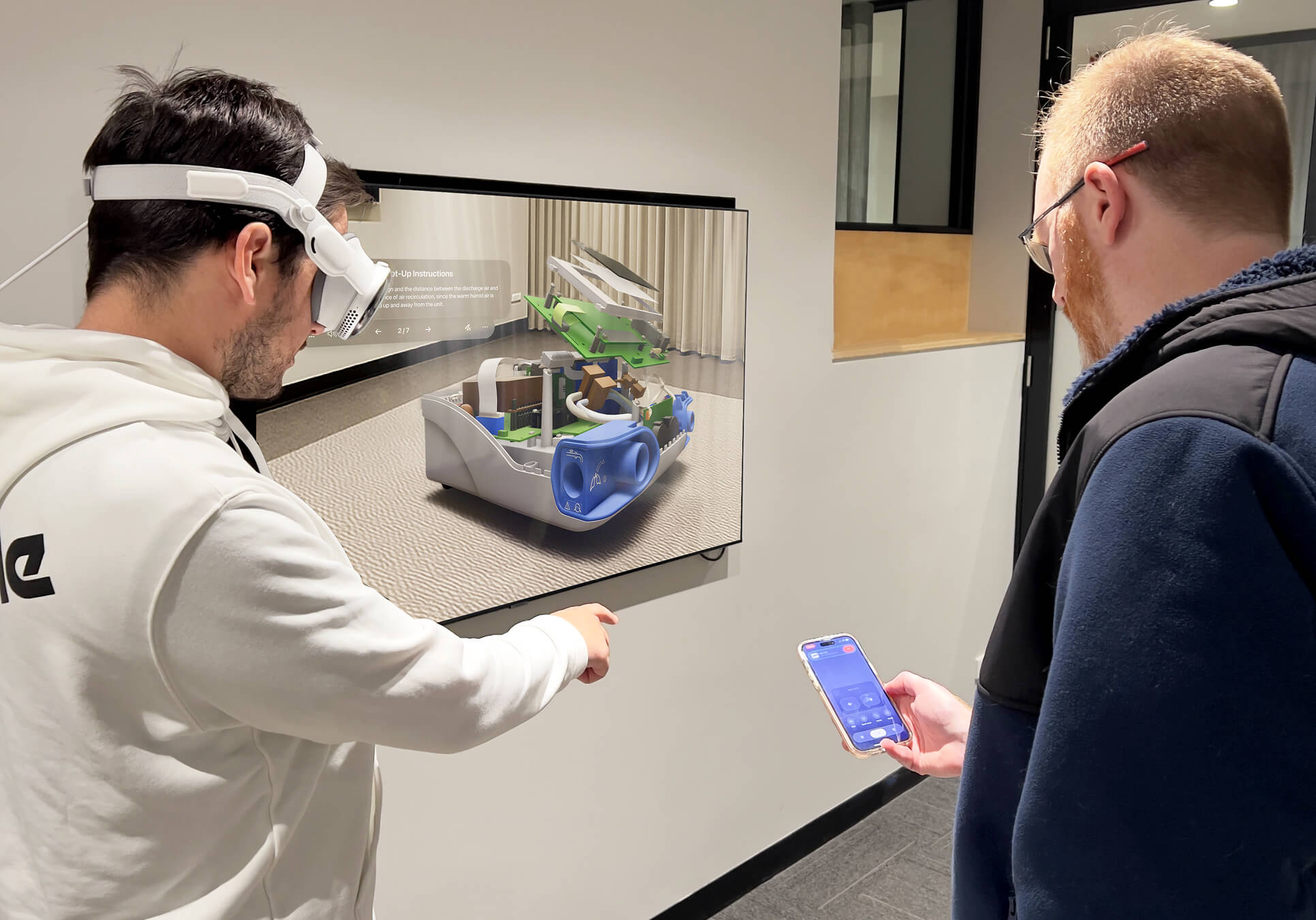
JigSpace Remote app for Vision Pro launched in September. We built it because we kept hearing the same problem from customers running trade show demos: guiding a first-time Vision Pro user through a presentation while they're wearing the headset is awkward. The person demonstrating can't see what the viewer sees, and the viewer is often distracted by learning the interface instead of focusing on the product.
Now, with an iPhone or iPad, you can control exactly what someone sees on Vision Pro. Launch Jigs remotely, navigate through steps, adjust settings — all while your customer stays immersed in the experience. It sounds simple, but it doubled the demonstration capacity for teams running busy booths.
We also added image anchoring so you can lock your Jig to a specific physical location using a tracking image. This is huge for trade shows where you want AR content to appear precisely on or around your physical equipment. Combine that with local SharePlay multiplayer — where multiple Vision Pro users can view the same Jig together in person, synchronized in real-time — and you have the foundation for truly collaborative spatial experiences.
And yes, we shipped visionOS 26 support on day one.
Customers Leading the Way
The best part of this job is watching customers take the tools we build and use them in ways that genuinely change how they do business. Three stories stood out this year.
Provisur at IFFA 2025
Provisur makes industrial food processing equipment — massive machines that form, slice, and package meat products at scale. Their VerTex TenderForm is impressive, but showing what makes it special at a trade show has always been a challenge. You can't exactly run a patty-forming demonstration on a crowded show floor.
At IFFA 2025, they tried something different. Using JigSpace on Apple Vision Pro and iPad, they created an interactive overlay that let attendees see inside the machine. This included the internal mechanics, the competitive differentiators, the workflow that's normally hidden behind metal panels.
The result: over 400 demos delivered across the show. Sales reps led guided tours on iPads while customers explored in AR. The booth became a magnet.
Scott Scriven, Provisur's Chief Marketing Officer, put it this way: "Our experience with Apple Vision Pro and JigSpace exceeded expectations. It significantly elevated the attendee experience by transforming a static piece of equipment into an engaging, interactive display. It empowered our account managers to clearly communicate what sets our machine apart from the competition. And it reinforced our position as industry leaders and innovators."
What started as a single trade show experiment is now expanding into a broader strategy. More products, more use cases, eventually training and post-sales support.
IKN's Spare Parts Transformation
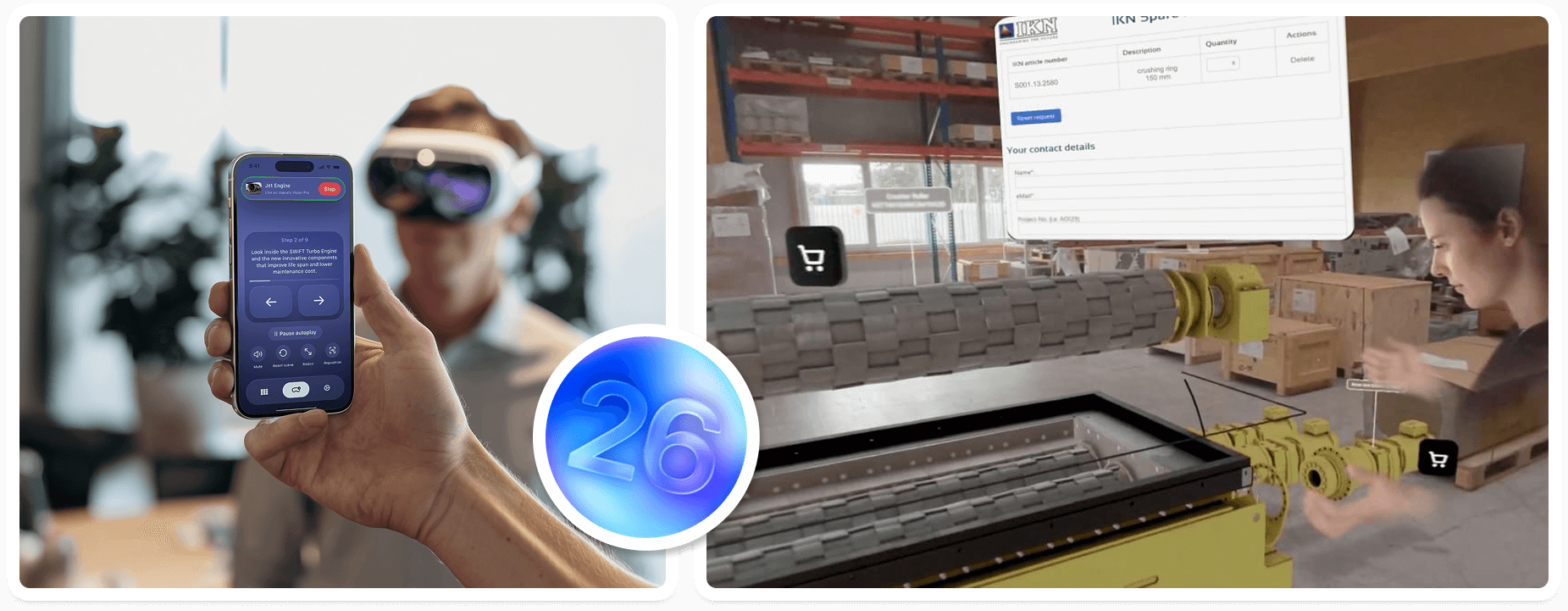
IKN builds clinker coolers and pyro processing equipment for cement plants. Their machines are massive, complex, and installed in over 700 locations worldwide. When something needs replacing, customers historically had to identify the correct spare part from static PDFs — scrolling through pages of similar-looking components, manually entering part numbers, hoping they got it right.
This year, IKN launched a new approach using JigSpace. Customers now interact with 3D digital twins of their equipment. Click on a component, see the part number and specs, add it directly to an order. When they submit, notifications go instantly to IKN's after-sales team.
Steve Dorn, IKN's Manager of After Sales and Services, said: "With JigSpace, IKN has reduced part identification errors, accelerated quoting, and created a far more efficient workflow."
They've also started using Vision Pro for remote support sessions. Customers and IKN's team can explore equipment together in immersive 3D, selecting and discussing parts in real-time without anyone getting on a plane. As Steve put it: "It delivers richer context, high-touch remote support, and reduces the need for onsite visits."
Sauber F1 Team
Our partnership with the Sauber F1 Team continued through 2025. We had the opportunity to host two standout events during the Dutch and Austin F1 weekends, and bring together some of our most innovative customers. It was a rare opportunity for teams across industries to connect, exchange ideas, and see how others are pushing the boundaries with JigSpace. We were especially fortunate to have partners from Evapco, St. Jude Children's Hospital, and IKN share their real-world applications with the wider group; super inspiring presentations that sparked a lot of new thinking.
And looking ahead: Sauber will transition to Audi F1 branding in 2026, and we'll be right there with them. More on that soon.
Building for Creators
Behind every success story is someone that needed to build a Jig. We spent a lot of 2025 making that process faster and more powerful.

Parenting and object hierarchy was one of our most requested features. Now you can drag and drop objects into parent-child relationships, which makes animating complex assemblies, like robotic arms, mechanical linkages, nested components, feel natural instead of tedious.
Orthographic camera views give you top, front, and side perspectives for precise alignment. Engineers asked for this constantly. Now it's a keyboard shortcut away.
Snapping tools — both surface and vertex snapping — let you connect objects with accuracy. Combined with the ability to set pivot points on any surface or corner, your models move and animate the way you'd expect.
Materials and textures per step unlocked a wave of creative possibilities. Switch a metal panel to x-ray mode to reveal internal components. Show different screens or gauges on each step. Display video footage on surfaces. All without duplicating meshes or bloating file sizes. We also import embedded textures and PBR materials from files like USDZ, GLB, and FBX as well.
Go-to-Jig actions let you link multiple Jigs into a seamless experience. Click an object and transition to another Jig without leaving immersive mode on Vision Pro. This is perfect for breaking large products into digestible sections or creating branching training modules where learners choose their own path.
For enterprise teams, we introduced a Team Admin role with full visibility over all content, the ability to transfer Jigs between users, and a redesigned admin dashboard. We also launched EU Data Residency for customers who need their data stored in Europe and full support for Enterprise SSO providers like Microsoft Entra ID.
Under the hood, we made the apps smaller and faster. The desktop apps are now over 200MB lighter, the apps automatically update when new versions are released, and common actions like loading and saving Jigs are noticeably quicker.
Recognition and Community
Some external highlights from the year:
Numa and I were named to the Australian Top 100 Innovators list. That kind of recognition is really a reflection of the whole team's work, but we'll take it.
Qantas Travel Insider featured JigSpace in their business section, telling the story of how we went from teaching video game design with frustrating PDFs to building a spatial computing platform used by manufacturers around the world.
At WWDC in June, we co-hosted a meetup with PTC, bringing together almost 100 people working in spatial computing across different industries. The conversations at events like these remind us why we're building what we're building — there's a genuine community forming around this technology.
And of course, the biggest recognition comes from our customers and creators who keep finding new ways to use JigSpace. You push us to be better. Thank you.
Looking Ahead to 2026
We're not slowing down.
Jig Spark AI, our generative AI tool, will launch later this year. Give it a CAD file and a link to your product webpage, and it generates a 3D interactive presentation. It's going to dramatically lower the barrier to creating spatial content, especially for teams without dedicated 3D specialists.
We'll keep investing in enterprise features, deeper integrations with the tools our customers already use, and creator capabilities that make building Jigs faster and more powerful.
Spatial computing is entering its most exciting chapter. The hardware is here. The software is ready. The customers are showing what's possible. Now, we scale.
Thank you to everyone who built with us, partnered with us, and believed in us this year. Here's to 2026!


